
Schenectady County Court Records After Jail Arrest
The local arrest-to-court path is described most clearly by the Schenectady County District Attorney City and Local Courts Bureau. When a person is arrested for a crime, the person is brought before a judge in the city, town, or village court where the crime occurred. After counsel is retained or appointed, arraignment occurs. The judge may remand the accused, set bail, impose release conditions, or release the person.
That process creates a difference between jail records and court records after an arrest. The jail can help confirm custody, bail information, visiting, and some records channels. The court record tracks the case itself: accusatory papers, charges, future appearances, amendments, reductions, dismissals, indictments, pleas, trials, and dispositions. For custody and booking questions, use Schenectady County jail inmate records. For booking photos, use Schenectady County jail mugshots.
Find Court Records After Arrest
New York WebCriminal is the free court portal documented in the research for selected criminal courts with future appearance dates. It has defendant, case identifier, and court calendar paths. Schenectady options documented in the portal include Schenectady City Court, Schenectady County Court, and Schenectady County Supreme Court. The portal warns about intermittent delays, so absence of a record should not be treated as proof that no case exists.
- Open WebCriminal and choose defendant search, case identifier search, or court calendar search.
- For defendant search, enter at least the first two characters of both first and last name.
- Narrow by Schenectady City Court, County Court, or Supreme Court when the court is known.
- For case identifier search, use a case number or summons number and select a court if known.
- Read charge and appearance details as court case information, not as a live jail roster.
Schenectady County Court Search Fields
WebCriminal search fields are useful because the county does not publish a public jail roster. Defendant search is name-based. Case identifier search works when a case number or summons number is already known. Calendar search can help locate scheduled appearances by court, date range, court part, and judge.
| Portal Path | Field | Required | Notes |
|---|---|---|---|
| Defendant Search | First Name | With Last Name | At least first two characters. |
| Defendant Search | Last Name | With First Name | At least first two characters. |
| Defendant Search | Court | Optional | Can select Schenectady City, County, or Supreme Court. |
| Case Identifier | Case # | Conditional | Use case number or summons number. |
| Court Calendar | Court and date range | Required | Start date, end date, and court selection are core fields. |
Schenectady County Arrest Charging Documents
Formal court records after a jail arrest come from court filings, not from the jail booking event alone. A police arrest may start with an accusation, but the court case is shaped by accusatory instruments, prosecutor review, grand jury action for some felonies, amendments, reductions, and later disposition. In Schenectady County, the District Attorney represents the People in village, town, city, and county courts.
| Document | Typical Role | Schenectady County Context |
|---|---|---|
| Complaint | Starts or supports a criminal accusation | Often appears early in local court processing. |
| Information | Formal accusatory paper for certain charges | Can define what the defendant must answer in court. |
| Indictment | Grand jury felony charging document | DA duties include presenting felony cases to the grand jury. |
What the DA Does After Arrest
The Schenectady County District Attorney's Office is led by Robert M. Carney and represents the People of the State of New York in criminal cases in Schenectady County's village, town, city, and county courts. The DA page lists duties that include grand jury presentation, hearings, trials, plea negotiations, and appeals. The office includes City/Local Court, County Court, Grand Jury, Appeals, Investigations/Financial Crimes, Major Crimes, and Special Victims bureaus.
For felonies, the DA local-court page says a judge may set a preliminary hearing. After that date, or sometimes earlier, the case is sent to Schenectady County Court and handled by a felony prosecutor. Misdemeanors and violations generally proceed on the next local court date. That is why court records after a jail arrest can appear first in a local court and later in County Court for felony prosecution.
Schenectady County Charge Status
A jail custody entry, a police accusation, and a court charge are not always identical. Charges can be filed, amended, reduced, added, dismissed, or resolved by plea or verdict. WebCriminal can show pending court appearances for covered courts, while OCA CHRS provides a paid statewide criminal history search with its own limits.
| Status | Meaning | Record Caution |
|---|---|---|
| Pending | The case or charge remains open. | Check future appearance dates and court updates. |
| Amended or reduced | The charge changed from the initial accusation. | Do not rely only on booking-level information. |
| Dismissed | The charge was ended by the court. | Other charges in the same case may remain. |
| Indicted | A grand jury filed felony charges. | The case may move to County Court. |
| Disposed | The charge or case reached an outcome. | Sealing rules may affect later access. |
Charges vs Convictions
Charges are accusations or filed counts. A conviction is a court outcome after a plea, verdict, or other adjudication. Court records after an arrest may show charges that never become convictions, charges that are reduced, or counts that are dismissed. That distinction matters for any reader comparing jail custody, WebCriminal appearances, and CHRS results.
| Record Type | What It Means | Where It May Appear |
|---|---|---|
| Arrest or booking allegation | Initial custody-related accusation | Jail or law-enforcement records, if released. |
| Court charge | Formal charge filed or pursued in court | WebCriminal, court clerk records, DA proceedings. |
| Conviction | Final finding or plea outcome | CHRS, court disposition records, some court files. |
Schenectady County Bail After Arrest
Bail and release decisions happen at arraignment or later court proceedings. The DA local-court page says the judge may remand, set bail, or release the accused. Schenectady corrections accepts cash, certified bank checks, and credit cards for bail. Remote bail is through GovPayNet, with a county-stated 7 percent fee. The payer needs the defendant's name, date of birth, court of jurisdiction, judge, and cash bail amount.
| Release Result | Meaning |
|---|---|
| Release | The court allows the person to leave custody under the court's terms. |
| Bail set | Money bail may be paid if legally available and no hold blocks release. |
| Remand | The court orders the person held. |
| Hold or detainer | Another agency, warrant, parole issue, federal matter, or ICE issue may prevent release. |
Schenectady County Court Search Sources
The New York WebCriminal portal is the main free court search source documented for criminal cases with future appearance dates.
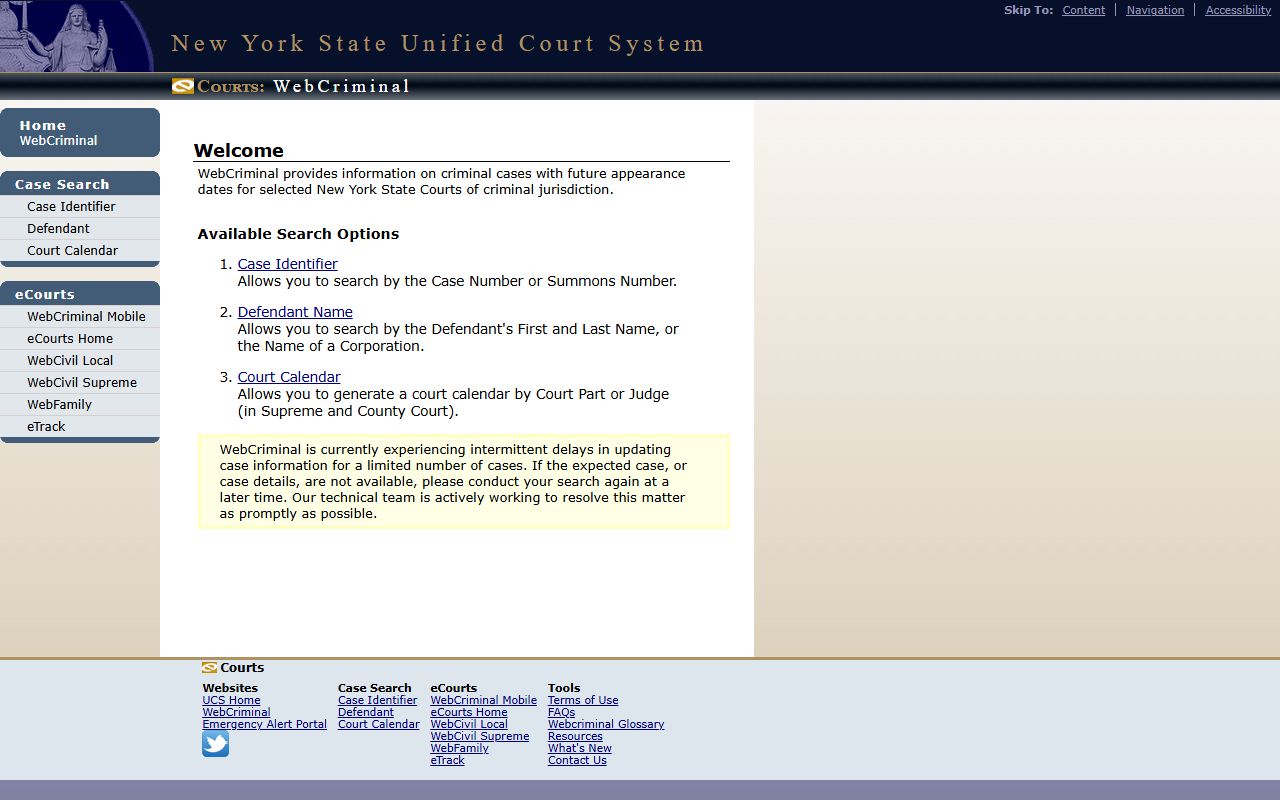
Its defendant, case identifier, and calendar paths are different from jail custody channels, which is why formal court records should be checked apart from inmate records.
OCA CHRS Criminal Records
The OCA Criminal History Record Search is a paid statewide exact-name-and-date-of-birth search. The public page states a $95 fee and says the search includes open or pending cases and convictions from County/Supreme, City, Town, and Village courts in all 62 counties, subject to limits. It is not a nationwide background check, not an FBI check, not certified, and not a Certificate of Disposition.
CHRS also has exclusions. Sealed records are not disclosed. The research notes limitations involving older town and village data, certain non-criminal offenses, youthful-offender eligible pending cases, Family Court transfers, sealed CPL 160.59 records, marijuana expungements, single old misdemeanor convictions, pardons, and missing-disposition cases. Use court clerks or a Certificate of Disposition when an official court-certified outcome is needed.
Sealed vs Expunged Records
New York court records after arrest can be limited by sealing. CPL 160.50 provides sealing when a criminal action terminates in favor of the accused, unless an exception applies. CPL 160.59 allows sealing of certain old convictions under conditions, and OCA notes that records sealed under CPL 160.59 are not disclosed in CHRS. New York also has marijuana-related expungement limits noted by OCA.
| Term | Meaning in Practice | Access Effect |
|---|---|---|
| Sealed | Record access is restricted by statute or court order. | May not appear in public court or CHRS results. |
| Expunged | Record treatment can remove or restrict public effect for specific legal categories. | Do not assume a public portal will show it. |
| Open public record | No sealing or exemption blocks the disclosed record. | May still require the proper court or agency request. |